
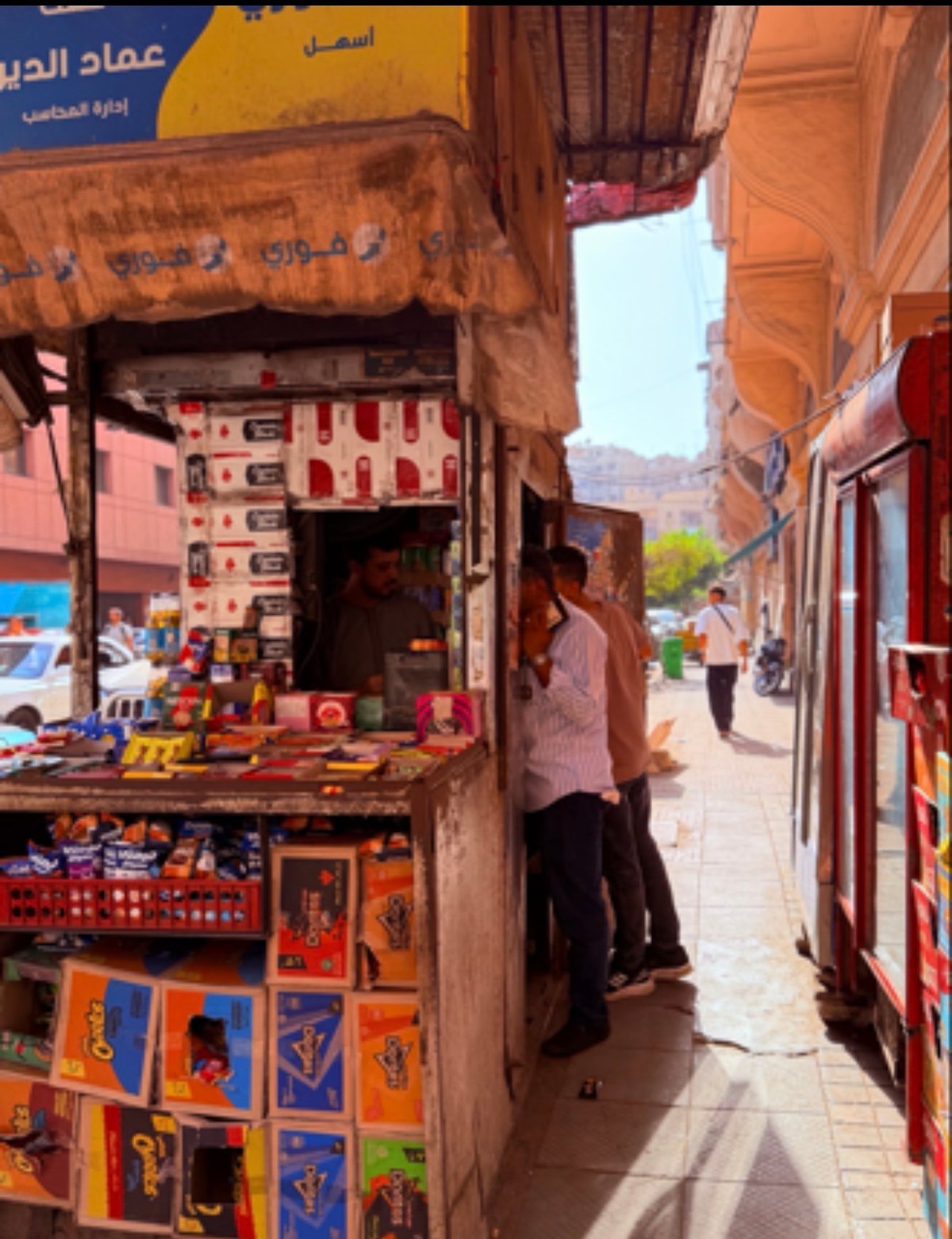
Whenever I walk through downtown Cairo, especially from Tahrir Square towards Talaat Harb, I feel a bewilderment that is hard to describe. Looking up, I find the buildings left from the late nineteenth and early twentieth centuries genuinely beautiful: high ceilings, corner balconies, wooden shutters and façades that recall European cities. If some of these stood in Paris, London or Milan, I can scarcely imagine what they would be worth today. In Cairo, many simply gather dust and grow older, year after year. Shops still operate on the ground floor of some, while the upper storeys look as though they have been abandoned for years. Air-conditioning units, cables and signs cling in layers to century-old walls.
It was almost three in the morning when I arrived this time. To my surprise, the streets were still full of people. Restaurants were lit, small shops remained open, cars kept honking, people sat talking by the roadside, and others simply lay down to sleep there. Rubbish, dust, chaotic traffic and street life that refused to stop even at that hour were all crowded together. The next afternoon, I walked through these streets to a five-star hotel beside the Nile. As I pushed through the door, air conditioning, marble, security, fragrance and international restaurants appeared all at once. Thinking back to the streets a few hundred metres away, I briefly felt that I had stepped into a different city.
This was not my first encounter with inequality, and I have visited places poorer than Egypt. What puzzled me was that Egypt hardly seemed a country without the conditions for development. It has the Suez Canal, the Red Sea and the Mediterranean; a location close to both Europe and the Middle East; more than a hundred million people and a large young workforce; and tourism resources that are almost impossible to replicate. Yet walking through Cairo, I kept returning to the same unpolished but direct question: what has happened to this country?
Four hundred Egyptian pounds on the Nile
That afternoon was hot. Eventually I gave up walking, and towards evening I took a ride on a traditional sailboat on the Nile.
An entire boat, one boatman, one hour: 400 Egyptian pounds, roughly fifty-odd Chinese yuan. Two months earlier, I had been travelling in Lugano, Switzerland, where a similar hour-long sailing trip on the lake cost about 80 to 90 Swiss francs. This was hardly a rigorous comparison. Labour, insurance, taxes, mooring costs and tourists’ spending power are on entirely different levels in Switzerland and Egypt. But with the two journeys so close together, the price difference was difficult to put out of my mind.
Before getting off, I gave the boatman an extra 20 Egyptian pounds as a tip. He was visibly pleased. At the time, that was less than three yuan. It was not an amount I would ordinarily remember, but his reaction made it stay with me.
Suddenly I wondered: how can the same hour of a person’s time command a price more than ten times higher—or an even greater multiple—in one society than in another?
It plainly cannot be because a Swiss boatman works more than ten times as hard as an Egyptian one. The price of someone’s labour is never determined by diligence alone. It also depends on the capital, technology, education and infrastructure available in their society; the productivity of its businesses; consumers’ purchasing power; and how much this whole environment can amplify the value of an individual’s work.
A person may work twelve hours a day. If that work consists of finding customers, running a stall, driving or tending a small shop with no economies of scale, they are certainly industrious, but diligence alone will not turn them into a high earner. By contrast, someone operating equipment in a modern factory, handling financial processes for a multinational company or developing software for global clients has machinery, capital, management, technology and a worldwide market working behind their hour.
That is why, when I looked again at the busy people on Cairo’s streets, I was reluctant to sum it all up as “vitality”. Cairo is certainly full of life: people still working at three in the morning are the clearest evidence of that. But a busy city and a city whose people can earn more from being busy are two different things.
Egypt has a decent hand to play
On a map, Egypt looks well placed to become a nearshore production and service base for Europe. It is close to Europe and the Gulf countries. It could develop textiles, automotive components, home appliances, food processing and logistics. Its English and Arabic language capabilities and time zone also offer advantages in business processes and digital outsourcing. My question was never really, “Why has Egypt not become Switzerland?” That would not be a reasonable question. What puzzled me more was why it had not at least followed an industrialisation path closer to Vietnam’s.
Nor has Egypt stood still in recent years. Information technology and outsourcing offer a good example. The latest official Egyptian figures put offshore service exports in 2025 at about US$5.2 billion, including IT, business processes and engineering services. Some major multinational outsourcing companies are also expanding rapidly in Egypt. This at least shows that its young population, languages and location can translate into competitiveness in global services.
But there are still nowhere near enough of these jobs. The World Bank estimates that about 1.3 million young people enter Egypt’s labour market each year, while only around 500,000 jobs are created. The private sector already contributes roughly three-quarters of GDP and employs more than four-fifths of workers. The problem, then, is not that Egypt has no private businesses, but that too few can raise productivity, expand sustainably and create large numbers of better jobs. Over the previous decade, private investment in Egypt averaged only 6.3 per cent of GDP—about one-fifth of the average for middle-income countries.
People who are not absorbed into modern manufacturing, professional services or large businesses do not stop working. They drive, run stalls, trade on a small scale or provide tourism services, entering the vast informal economy. These jobs make Cairo extraordinarily active, but they struggle to keep raising labour productivity in the way that manufacturing, technology services or established firms can.
A young population therefore never automatically becomes a demographic dividend. Only when education, industries and jobs can accommodate those young people does the population become an advantage. Otherwise, more than a million young people entering the market each year is itself a tremendous pressure.
Building a city in the desert, maintaining an old street
Yet Egypt is clearly not a country incapable of undertaking major projects. On the contrary, this may be what I find most contradictory about it.
East of Cairo, a new administrative capital rises from the desert. Government institutions, roads, a central business district, vast religious buildings and skyscrapers have gradually appeared on land that was once almost empty. Reuters has put the scale of the entire project at about US$58 billion. Over the past decade and more, Egypt has also built roads, bridges and other infrastructure on a large scale. Supporters argue that old Cairo has long been overburdened by population and administration, and that new cities and transport investment are essential to modernisation. Critics have repeatedly questioned whether these megaprojects absorb too many resources when government debt and the pressures on people’s livelihoods are already so heavy.
I do not think the answer is simply, “They should not have built a new capital; they should have spent the money collecting rubbish.” A country of more than a hundred million people needs infrastructure, and new cities, roads and railways may have long-term value. But all public investment has an opportunity cost. What a country consistently puts first gradually shapes the development ordinary people actually experience.
Building a new city in the desert is highly visible. A completed bridge can have a ribbon-cutting ceremony; a skyscraper can feature in aerial footage; new roads and administrative districts have definite completion dates. By contrast, keeping an ordinary street clean for twenty years, preventing a century-old residential building from decaying, collecting rubbish on time every day or sustaining the quality of a public school are jobs with no day on which they are “finished”. Yet a city’s quality of life is maintained, little by little, by precisely these less conspicuous things.
Standing beneath the old buildings of downtown Cairo, I increasingly felt that Egypt did not lack the ability to concentrate resources on large projects. What seemed weaker was the more ordinary, piecemeal work of urban governance that requires sustained investment over decades. It can transform a desert skyline in a short time, yet struggles to apply the same patience to maintaining a street that has existed for a hundred years.
This is not merely a question of whether the rubbish gets swept up. Old rental agreements, ownership, local finances, municipal capacity and the wider economic structure are all entangled. In recent years, the World Bank and the IMF have repeatedly argued that, if Egypt is to make the private sector a real engine of growth, it needs to reduce the state’s role in competitive economic activities and improve fair competition and the investment environment. In other words, Egypt has spent a great deal of money. The difficulty is turning that spending into more private investment, better jobs and productivity gains that ordinary people can actually feel.
Nor is Egypt without economic growth today. Real GDP grew by 4.4 per cent in the 2024/25 fiscal year. That only deepened my puzzlement: if GDP is still growing, roads are still being built and new cities are still appearing, why does a visitor to the centre of the capital feel such a powerful sense of disrepair, dust and the deterioration of public space?
Increasingly, I wanted to ask not whether Egypt was developing, but where that development had gone—and how much of it had reached ordinary lives.
Fifty Egyptian pounds
On the way from Cairo to the airport, another small incident stayed with me. My Uber driver kept telling me there was an additional airport entrance fee of 50 Egyptian pounds. I checked Uber’s rules, which said the airport charges were already included in the booking, and showed him the page. As we approached the drop-off, he told me that what the platform included was the “entrance fee”; there was also an “exit fee”.
When he saw that I still had no intention of paying extra, he finally just shook his head, looking somewhat resigned.
Rules are rules. If the platform had already charged the fee, I had no reason to pay it twice. But what stayed with me was not whether I had saved those 50 pounds. It was that final shake of his head.
Fifty Egyptian pounds meant little to me. Clearly, it did not mean little to him.
I kept thinking of the boatman’s smile when he received his 20-pound tip. Twenty and fifty pounds were small figures in my hands, but evidently not in theirs. I do not want to use this to excuse unreasonable charges, or to stand in a tourist’s position and pity anyone. It is simply that, when the income gap becomes wide enough, the same small amount of money carries very different weight in different people’s days.
When discussing a country’s development, we tend to look at GDP, foreign exchange, exports, investment and major projects. These figures matter. In 2023, the Suez Canal recorded its highest-ever annual revenue of US$10.25 billion. In 2024, affected by the Red Sea shipping crisis, that fell sharply to US$3.991 billion. That enormous swing is another reminder: canals, tourism, oil, population and geography are assets that can be used for development. They do not turn themselves into ordinary people’s incomes and quality of life.
Ultimately, the difficult part is gradually turning a decent hand of cards into work that pays more for tens of millions of people.
What is an hour really worth?
Later, I remembered a cycle-rickshaw ride in Agra, India, ten years earlier. The man pedalled me around for more than an hour, up and down slopes. Converted into yuan, the fare was less than ten. I still remember it, not because the ride was especially remarkable, but because it was probably the first time I understood, in such concrete terms, how cheaply a person’s time could be priced.
Ten years later, in Cairo, a sailboat, a boatman and one hour cost 400 Egyptian pounds. Two months earlier in Lugano, it had been 80 to 90 Swiss francs.
These three figures cannot be used as a direct economic comparison. But they made an abstract question suddenly concrete. What raises the value of a person’s time is not simply how hard they work. It is better education, more efficient businesses, more capital and technology, and a society able to pay more for that work.
So, as I left Cairo for the third time, my understanding of “development” became simpler than it had been before.
I will still remember those century-old buildings covered in desert dust, the streets that had not gone to sleep at three in the morning, and the breeze on the Nile at sunset. But when asking what this country lacks, I am less inclined to settle for words such as “poor”, “chaotic” or “badly governed”.
Egypt does not lack resources. It has received investment, and its people certainly do not lack effort. What I find regrettable is that these conditions have not yet translated fully into ordinary people’s productivity and incomes, or into a quality of life they can feel each day as they step outside their homes.
A country’s development may be about more than how high it can build in the desert, or how large a new city it can create.
In the end, it still has to answer a very ordinary question: in this country, what is one hour of an ordinary person’s time really worth?